Ch 7 — Handling AST
Handling AST In the previous chapter, we learned how Clang's preprocessor handles preprocessing directives in C-family languages. We also learned how to write different kinds of preprocessor plugins, such as pragma handlers, to extend Clang's functionalities. Those skills are especially useful when it comes to implementing field-specific logic or even custom language features. In this chapter, we're going to talk about a semantic-aware representation of the original source code file once it has been parsed, known as an Abstract Syntax Tree (AST). An AST is a format that carries rich semantic information, including types, expression trees, and symbols, to name a few. It is not only used as a blueprint to generate LLVM IR for later compilation stages but is also the recommended format for performing static analysis. On top of that, Clang also provides a nice framework for developers to intercept and manipulate AST in the middle of the frontend pipeline via a simple plugin interface. In this chapter, we are going to cover how to process AST in Clang, the important APIs for in-memory AST representation, and how to write AST plugins to implement custom logic with little effort. We will cover the following topics:
• Learning about AST in Clang • Writing AST plugins
112 Handling AST
By the end of this chapter, you will know how to work with AST in Clang in order to analyze programs at the source code level. In addition, you will know how to inject custom AST processing logic into Clang in an easy way via AST plugins.
Technical requirements This chapter expects that you have a build of the clang executable. If you don't, please build it using the following command:
$ ninja clang
In addition, you can use the following command-line flag to print out the textual representation of AST:
$ clang -Xclang -ast-dump foo.c
For example, let's say foo.c contains the following content:
int foo(int c) { return c + 1; }
By using the -Xclang -ast-dump command-line flag, we can print out AST for foo.c:
  TranslationUnitDecl 0x560f3929f5a8 <<invalid sloc>> <invalid
  sloc>
  |…
  `-FunctionDecl 0x560f392e1350 <foo.c:2:1, col:30> col:5 foo
  'int (int)'
     |-ParmVarDecl 0x560f392e1280 <col:9, col:13> col:13 used c
  'int'
     `-CompoundStmt 0x560f392e14c8 <col:16, col:30>
       `-ReturnStmt 0x560f392e14b8 <col:17, col:28>
         `-BinaryOperator 0x560f392e1498 <col:24, col:28> 'int'
  '+'
           |-ImplicitCastExpr 0x560f392e1480 <col:24> 'int'
  <LValueToRValue>
           | `-DeclRefExpr 0x560f392e1440 <col:24> 'int' lvalue
  ParmVar 0x560f392e1280 'c' 'int'
           `-IntegerLiteral 0x560f392e1460 <col:28> 'int' 1
Learning about AST in Clang 113
This flag is useful for finding out what C++ class is used to represent a certain part of the code. For example, the formal function parameter/argument is represented by the ParmVarDecl class, which is highlighted in the previous code. The code samples for this chapter can be found here: https://github.com/ PacktPublishing/LLVM-Techniques-Tips-and-Best-Practices-Clangand-Middle-End-Libraries/tree/main/Chapter07.
Learning about AST in Clang In this section, we are going to learn about Clang's AST in-memory representation and its essential API usage. The first part of this section will provide you with a high-level overview of Clang AST's hierarchy; the second part will focus on a more specific topic regarding type representation in Clang AST; and the final part will show you the basic usage of AST matcher, which is extremely useful when you're writing an AST plugin.
In-memory structure of Clang AST The in-memory representation of AST in Clang is organized in a hierarchy structure that resembles the syntax structure of C-family language programs. Starting from the top-most level, there are two classes worth mentioning:
   • TranslationUnitDecl: This class represents an input source file, also called
     a translation unit (most of the time). It contains all the top-level declarations –
     global variables, classes, and functions, to name a few – as its children, where each
     of those top-level declarations has its own subtree that recursively defines the rest of
     the AST.
   • ASTContext: As its name suggests, this class keeps track of all the AST nodes and
     other metadata from the input source files. If there are multiple input source files,
     each of them gets its own TranslationUnitDecl, but they all share the same
     ASTContext.
In addition to the structure, the body of the AST – the AST nodes – can be further classified into three primary categories: declaration, statement, and expression. The nodes in these categories are represented by subclasses derived from the Decl, Expr, and Stmt classes, respectively. In the following sections, we are going to introduce each of these in-memory AST representations.
114 Handling AST
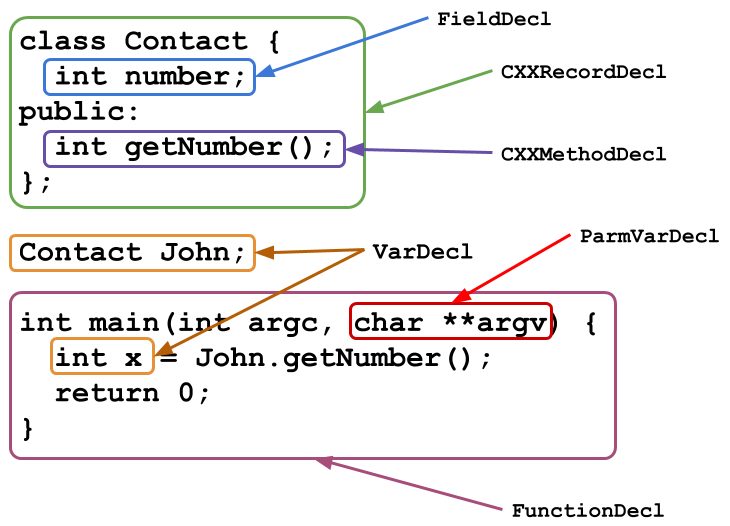
Declarations Language constructs such as variable declarations (global and local), functions, and struct/class declarations are represented by subclasses of Decl. Though we are not going to go into each of these subclasses here, the following diagram shows common declaration constructions in C/C++ and their corresponding AST classes:
Figure 7.1 – Common declarations in C/C++ and their AST classes Between more concrete subclasses, such as FunctionDecl and Decl, there are several important abstract classes that represent certain language concepts:
   • NamedDecl: For every declaration that has a name.
   • ValueDecl: For declarations whose declared instances can be a value, and thus are
     associated with type information.
   • DeclaratorDecl: For every declaration that uses declarator (basically a
     statement in the form of <type and qualifier> <identifier name>).
     They provide extra information about parts other than the identifier. For example,
     they provide access to an in-memory object with namespace resolution, which acts
     as a qualifier in the declarator.
To learn more about AST classes for other kinds of declarations, you can always navigate through the subclasses of Decl on LLVM's official API reference website.
Learning about AST in Clang 115
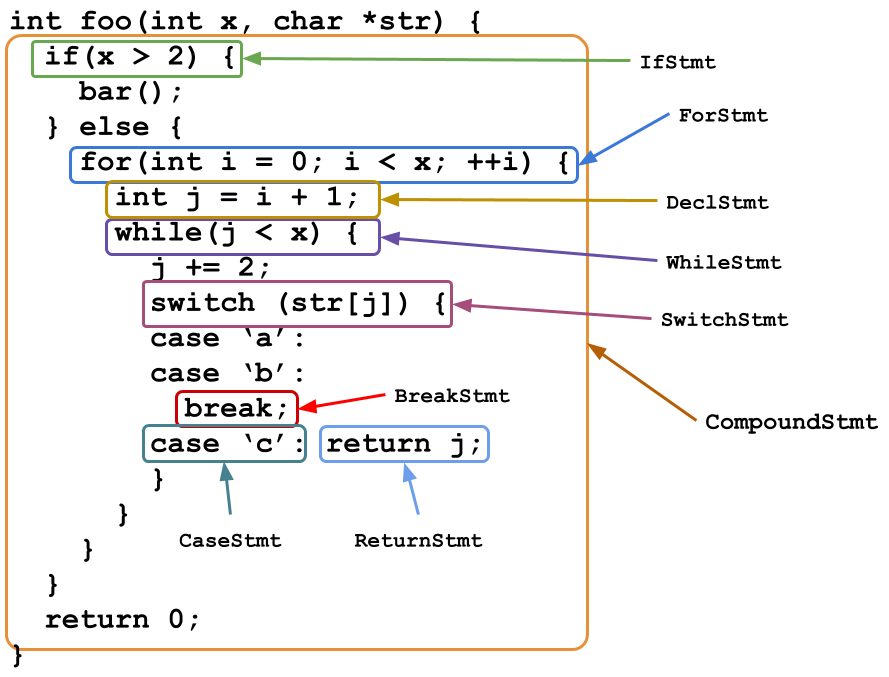
Statements Most directives in a program that represent the concept of actions can be classified as statements and are represented by subclasses of Stmt, including expressions, which we are going to cover shortly. In addition to imperative statements such as function calls or return sites, Stmt also covers structural concepts such as for loops and if statements. Here is a diagram showing a common language construct represented by Stmt (except expression) in C/C++ and its corresponding AST classes:
      Figure 7.2 – Common statements (excluding expressions) in C/C++ and their AST classes
There are two things worth mentioning about the previous diagram:
   • CompoundStmt, which is a container for multiple statements, represents not only
     the function body but basically any code block enclosed by curly braces ('{',
     '}'). Therefore, though not shown in the preceding diagram due to a lack of space,
     IfStmt, ForStmt, WhileStmt, and SwitchStmt all have a CompoundStmt
     child node representing their bodies.
   • Declarations in a CompoundStmt will be wrapped by a DeclStmt node, in which
     the real Decl instance is its child node. This creates a simpler AST design.
Statements are one of the most prevailing directives in a typical C/C++ program. It is worth noting, however, that many statements are organized in a hierarchy (for example, ForStmt and its loop body), so it might take you extra steps to go down this hierarchy before you find the desired Stmt node.
116 Handling AST
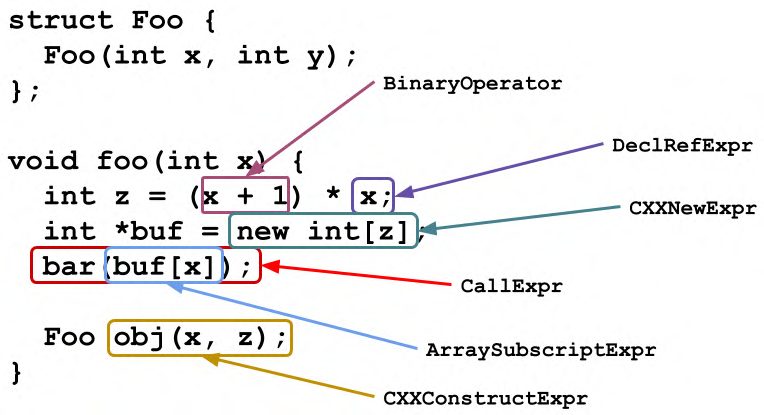
Expressions Expressions in Clang AST are a special kind of statement. Different from other statements, expressions always generate values. For example, a simple arithmetic expression, 3 + 4, is expected to generate an integer value. All expressions in Clang AST are represented by subclasses of Expr. Here is a diagram showing a common language construct represented by Expr in C/C++ and its corresponding AST classes:
Figure 7.3 – Common expressions in C/C++ and their AST classes One important Expr class is DeclRefExpr. It represents the concept of symbol reference. You can use one of its APIs, DeclRefExpr::getDecl(), to retrieve the referenced symbol's Decl object. Handy symbol information like this only appears after AST has been generated, so this is one of the reasons people always recommend implementing static analysis logic on AST rather on more primitive forms (inside the parser, for example). Another interesting Expr class – not highlighted in the preceding diagram due to a lack of space – is ParenExpr, which represents the parentheses that wrap around an expression. For example, in the preceding diagram, (x + 1) is a ParenExpr with a BinaryOperator representing x + 1 as its child.
Types in Clang AST The type system is one of the most crucial components in modern compilers, especially for statically typed languages such as C/C++. Type checking ensures that the input source code is well-formed (to some extent) and catches as many errors as possible at compile time. While we don't need to do type checking by ourselves in Clang, it is done by the Sema subsystem, which we introduced in Chapter 5, Exploring Clang's Architecture. You will probably need to leverage this information when you're processing the AST. Let's learn how types are modeled in Clang AST.
Learning about AST in Clang 117
Core classes The core of Clang AST's type system is the clang::Type class. Each type in the input code – including primitive types such as int and user-defined types such as struct/class – is represented by a singleton type (more specifically, a subclass of Type) object.
        Terminology
        In the rest of this chapter, we will call types in the input source code source
        code types.
A singleton is a design pattern that forces a resource or an abstract concept to be represented by only one in-memory object. In our case, source code types are the resources, so you will find only one Type object for each of those types. One of the biggest advantages of this design is that you have an easier way to compare two Type objects. Let's say you have two Type pointers. By doing a simple pointer comparison (which is extremely fast) on them, you can tell if they're representing the same source code type.
        Counter Example of a Singleton Design
        If Type in Clang AST is not using a singleton design, to compare if two Type
        pointers are representing the same source code types, you need to inspect the
        content of the objects they are pointing to, which is not efficient.
As we mentioned earlier, each source code type is actually represented by a subclass of Type. Here are some common Type subclasses:
   • BuiltinType: For primitive types such as int, char, and float.
   • PointerType: For all the pointer types. It has a function called
     PointerType::getPointee() for retrieving the source code type being
     pointed to by it.
   • ArrayType: For all the array types. Note that it has other subclasses for more
     specific arrays that have either a constant or variable length.
   • RecordType: For struct/class/union types. It has a function called
     RecordType::getDecl() for retrieving the underlying RecordDecl.
   • FunctionType: For representing a function's signature; that is, a function's
     argument types and return type (and other properties, such as its calling
     convention).
Let us now move on to the qualified types.
118 Handling AST
Qualified types One of the most confusing things for people new to Clang's code base is that many places use the QualType class rather than subclasses of Type to represent source code types. QualType stands for qualified type. It acts as a wrapper around Type to represent concepts such as const <type>, volatile <type>, and restrict <type>*. To create a QualType from a Type pointer, you can use the following code:
// If `T` is representing 'int'… QualType toConstVolatileTy(Type *T) { return QualType(T, Qualifier::Const | Qualifier::Volatile); } // Then the returned QualType represents `volatile const int`
In this section, we learned about the type system in Clang AST. Let's now move on to ASTMatcher, a syntax to match patterns.
ASTMatcher When we are dealing with a program's AST – for example, we're checking if there is any suboptimal syntax – searching for specific AST nodes pattern is usually the first step, and one of the most common things people do. Using the knowledge we learned in the previous section, we know that this kind of pattern matching can be done by iterating through AST nodes via their in-memory classes APIs. For example, given a FunctionDecl – the AST class of a function – you can use the following code to find out if there is a while loop in its body and if the exit condition of that loop is always a literal Boolean value; that is, true:
  // `FD` has the type of `const FunctionDecl&`
  const auto* Body = dyn_cast<CompoundStmt>(FD.getBody());
  for(const auto* S : Body->body()) {
    if(const auto* L = dyn_cast<WhileStmt>(S)) {
      if(const auto* Cond = dyn_cast<CXXBoolLiteralExpr>
        (L->getCond()))
        if(Cond->getValue()) {
          // The exit condition is `true`!!
        }
    }
  }
Learning about AST in Clang 119
As you can see, it created more than three (indention) layers of if statements to complete such a simple check. Not to mention in real-world cases, we need to insert even more sanity checks among these lines! While Clang's AST design is not hard to understand, we need a more concise syntax to complete pattern matching jobs. Fortunately, Clang has already provided one – the ASTMatcher. ASTMatcher is the utility that helps you write AST pattern matching logic via a clean, concise, and efficient Domain-Specific Language (DSL). Using ASTMatcher, doing the same matching shown in the previous snippet only takes few lines of code:
  functionDecl(compountStmt(hasAnySubstatement(
    whileStmt(
      hasCondition(cxxBoolLiteral(equals(true)))))));
Most of the directives in the preceding snippet are pretty straightforward: function calls such as compoundStmt(…) and whileStmt(…) check if the current node matches a specific node type. Here, the arguments in these function calls either represent pattern matchers on their subtree or check additional properties of the current node. There are also other directives for expressing qualifying concepts (for example, for all substatements in this loop body, a return value exists), such as hasAnySubstatement(…), and directives for expressing data type and constant values such as the combination of cxxBoolLiteral(equals(true)). In short, using ASTMatcher can make your pattern matching logic more expressive. In this section, we showed you the basic usage of this elegant DSL.
Traversing AST Before we dive into the core syntax, let's learn how ASTMatcher traverses AST and how it passes the result back to users after the matching process is completed. MatchFinder is a commonly used driver for the pattern matching process. Its basic usage is pretty simple:
using namespace ast_matchers; … MatchFinder Finder; // Add AST matching patterns to `MatchFinder` Finder.addMatch(traverse(TK_AsIs, pattern1), Callback1); Finder.addMatch(traverse(TK_AsIs, pattern2), Callback2); … // Match a given AST. `Tree` has the type of `ASTContext&`
120 Handling AST
// If there is a match in either of the above patterns, // functions in Callback1 or Callback2 will be invoked // accordingly Finder.matchAST(Tree);
// …Or match a specific AST node. `FD` has the type of // `FunctionDecl&` Finder.match(FD, Tree);
pattern1 and pattern2 are pattern objects that are constructed by DSL, as shown previously. What's more interesting is the traverse function and the TK_AsIs argument. The traverse function is a part of the pattern matching DSL, but instead of expressing patterns, it describes the action of traversing AST nodes. On top of that, the TK_AsIs argument represents the traversing mode. When we showed you the command-line flag for dumping AST in textual format (-Xclang -ast-dump) earlier in this chapter, you may have found that many hidden AST nodes were inserted into the tree to assist with the program's semantics rather than representing the real code that was written by the programmers. For example, ImplicitCastExpr is inserted in lots of places to ensure the program's type correctness. Dealing with these nodes might be a painful experience when you're composing pattern matching logic. Thus, the traverse function provides an alternative, simplified, way to traverse the tree. Let's say we have the following input source code:
struct B { B(int); }; B foo() { return 87; }
When you pass TK_AsIs as the first argument to traverse, it observes the tree, similar to how -ast-dump does:
  FunctionDecl
  `-CompoundStmt
    `-ReturnStmt
      `-ExprWithCleanups
        `-CXXConstructExpr
          `-MaterializeTemporaryExpr
            `-ImplicitCastExpr
               `-ImplicitCastExpr
Learning about AST in Clang 121
                     `-CXXConstructExpr
                       `-IntegerLiteral 'int' 87
However, by using TK_IgnoreUnlessSpelledInSource as the first argument, the tree that's observed is equal to the following one:
  FunctionDecl
  `-CompoundStmt
    `-ReturnStmt
      `-IntegerLiteral 'int' 87
As its name suggests, TK_IgnoreUnlessSpelledInSource only visit nodes that are really shown in the source code. This greatly simplifies the process of writing a matching pattern since we don't need to worry about the nitty-gritty details of AST anymore. On the other hand, Callback1 and Callback2 in the first snippet are MatchFinder::MatchCallback objects that describe the actions to perform when there is a match. Here is the skeleton of a MatchCallback implementation:
  struct MyMatchCallback : public MatchFinder::MatchCallback {
     void run(const MatchFinder::MatchResult &Result) override {
       // Reach here if there is a match on the corresponding
       // pattern
       // Handling "bound" result from `Result`, if there is any
     }
  };
In the next section, we will show you how to bind a specific part of the pattern with a tag and retrieve it in MatchCallback. Last but not least, though we used MatchFinder::match and MatchFinder::matchAST in the first snippet to kick off the matching process, there are other ways to do this. For example, you can use MatchFinder::newASTConsumer to create an ASTConsumer instance that will run the described pattern matching activity. Alternatively, you can use ast_matchers::match(…) (not a member function under MatchFinder but a standalone function) to perform matching on a provided pattern and ASTContext in a single run, before returning the matched node.
122 Handling AST
ASTMatcher DSL ASTMatcher provides an easy-to-use and concise C++ DSL to help with matching AST. As we saw earlier, the structure of the desired pattern is expressed by nested function calls, where each of these functions represents the type of AST node to match. Using this DSL to express simple patterns cannot be easier. However, when you're trying to compose patterns with multiple conditions/predicates, things get a little bit more complicated. For example, although we know a for loop (for example, for(I = 0; I < 10; ++I){…}) can be matched by the forStmt(…) directive, how do we add a condition to its initialize statement (I = 0 ) and exit the condition (I < 10) or its loop body? Not only does the official API reference site (the doxygen website we usually use) lacks clear documentation on this part, most of these DSL functions are also pretty flexible in how they accept a wide range of arguments as their subpatterns. For example, following the question on matching a for loop, you can use the following code to check only the loop's body:
forStmt(hasBody(…));
Alternatively, you can check its loop body and its exit condition, like so:
  forStmt(hasBody(…),
          hasCondition(…));
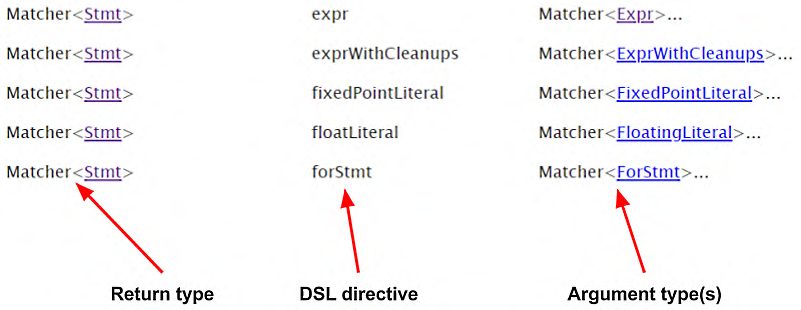
A generalized version of this question would be, given an arbitrary DSL directive, how do we know the available directives that can be combined with it? To answer this question, we will leverage a documentation website LLVM specifically created for ASTMatcher: https://clang.llvm.org/docs/ LibASTMatchersReference.html. This website consists of a huge three-column table showing the returned type and argument types for each of the DSL directives:
Figure 7.4 – Part of the ASTMatcher DSL reference
Learning about AST in Clang 123
Though this table is just a simplified version of normal API references, it already shows you how to search for candidate directives. For example, now that you know forStmt(…) takes zero or multiple Matcher<ForStmt>, we can search this table for directives that return either Matcher<ForStmt> or Matcher<(parent class of ForStmt)>, such as Matcher<Stmt>. In this case, we can quickly spot hasCondition, hasBody, hasIncrement, or hasLoopInit as candidates (of course, many other directives that return Matcher<Stmt> can also be used). When you're performing pattern matching, there are many cases where you not only want to know if a pattern matches or not but also get the matched AST nodes. In the context of ASTMatcher, its DSL directives only check the type of the AST nodes. If you want to retrieve (part of the) concrete AST nodes that are being matched, you can use the bind(…) API. Here is an example:
  forStmt(
    hasCondition(
      expr().bind("exit_condition")));
Here, we used expr() as a wildcard pattern to match any Expr node. This directive also calls bind(…) to associate the matched Expr AST node with the name exit_ condition. Then, in MatchCallback, which we introduced earlier, we can retrieve the bound node by using the following code:
  …
  void run(const MatchFinder::MatchResult &Result) override {
    cons auto& Nodes = Result.Nodes;
    const Expr* CondExpr = Nodes.getNodeAs<Expr>
      ("exit_condition");
    // Use `CondExpr`…
  }
The getNodeAs<…>(…) function tries to fetch the bound AST node under the given name and cast it to the type suggested by the template argument. Note that you're allowed to bind different AST nodes under the same name, in which case only the last bounded one will be shown in MatchCallback::run.
Putting everything together Now that you've learned about both the pattern matching DSL syntax and how to traverse AST using ASTMatcher, let's put these two things together.
124 Handling AST
Let's say we want to know the number of iterations – also known as the trip count – that a simple for loop (the loop index starts from zero and is incremented by one at each iteration and bounded by a literal integer) has in a function:
  1. First, we must write the following code for matching and traversing:
         auto PatExitCondition = binaryOperator(
                                    hasOperatorName("<"),
                                    hasRHS(integerLiteral()
                                    .bind("trip_count")));
         auto Pattern = functionDecl(
                          compountStmt(hasAnySubstatement(
                        forStmt(hasCondition(PatExitCondition)))));
         MatchFinder Finder;
         auto* Callback = new MyMatchCallback();
         Finder.addMatcher(traverse(TK_IgnoreUnlessSpelledInSource,
                                    Pattern), Callback);
      The preceding snippet also shows how modular DSL patterns are. You can create
      individual pattern fragments and compose them depending on your needs, as long
      as they're compatible.
      Finally, here is what MyMatchCallback::run looks like:
         void run(const MatchFinder::MatchResult &Result) override
         {
           const auto& Nodes = Result.Nodes;
           const auto* TripCount =
                 Nodes.getNodeAs<IntegerLiteral>("trip_count");
           if (TripCount)
             TripCount->dump(); // print to llvm::errs()
         }
  2. After this, you can use Finder to match the desired pattern (either by calling
     MatchFinder::match or MatchFinder::matchAST, or by creating an
     ASTConsumer using MatchFinder::newASTConsumer) on an AST. The
     matched trip count will be printed to stderr. For instance, if the input source
     code is for(int i = 0; i < 10; ++i) {…}, the output will simply be 10.
Writing AST plugins 125
In this section, we learned how Clang structures its AST, how Clang AST is represented in memory, and how to use ASTMatcher to help developers with AST pattern matching. With this knowledge, in the next section, we will show you how to create an AST plugin, which is one of the easiest ways to inject custom logic into Clang's compilation pipeline.
Writing AST plugins In the previous section, we learned how AST is represented in Clang and learned what its in-memory classes look like. We also learned about some useful skills we can use to perform pattern matching on Clang AST. In this section, we will learn how to write plugins that allow you to insert custom AST processing logic into Clang's compilation pipeline. This section will be divided into three parts:
   • Project overview: The goal and overview of the demo project we are going to create
     in this section.
   • Printing diagnostic messages: Before we dive into the core of developing a plugin,
     we are going to learn how to use Clang's DiagnosticsEngine, a powerful
     subsystem that helps you print out well-formatted and meaningful diagnostic
     messages. This will make our demo project more applicable to real-world scenarios.
   • Creating the AST plugin: This section will show you how to create an AST plugin
     from scratch, fill in all the implementation details, and how to run it with Clang.
Project overview In this section, we will create a plugin that prompts the user with warning messages whenever there are if-else statements in the input code that can be converted into ternary operators.
        Quick Refresher – Ternary Operator
        The ternary operator, x? val_1 : val_2, is evaluated to val_1 when
        the x condition is true. Otherwise, it is evaluated to val_2.
126 Handling AST
For example, let's look at the following C/C++ snippet:
  int foo(int c) {
    if (c > 10) {
      return c + 100;
    } else {
      return 94;
    }
  }
  void bar(int x) {
    int a;
    if (x > 10) {
      a = 87;
    } else {
      a = x – 100;
    }
  }
The if-else statements in both functions can be converted into ternary operators, like this:
int foo(int c) { return c > 10? c + 100 : 94; }
  void bar(int x) {
    int a;
    a = x > 10? 87 : x – 100;
  }
In this project, we will only focus on finding two kinds of potential ternary operator opportunities:
   • Both the then block (true branch) and the else block (false branch) contain a
     single return statement. In this case, we can coalesce their return values and the
     branch condition into one ternary operator (as the new returned value).
Writing AST plugins 127
   • Both the then block and the else block only contain a single assignment
     statement. Both statements use a single DeclRefExpr – that is, a symbol reference
     – as the LHS, and both DeclRefExpr objects point to the same Decl (symbol). In
     other words, we are covering the case of the bar function shown in the preceding
     snippet. Note that we are not covering cases where the LHS is more complicated; for
     example, where an array subscription, a[i], is used as the LHS.
After identifying these patterns, we must prompt warning messages to the user and provide extra information to help the user fix this issue:
  $ clang …(flags to run the plugin) ./test.c
  ./test.c:2:3: warning: this if statement can be converted to
  ternary operator:
    if (c > 10) {
    ^
  ./test.c:3:12: note: with true expression being this:
      return c + 100;
              ^
  ./test.c:5:12: note: with false expression being this:
      return 94;
              ^
  ./test.c:11:3: warning: this if statement can be converted to
  ternary operator:
    if (x > 10) {
    ^
  ./test.c:12:9: note: with true expression being this:
      a = 87;
          ^
  ./test.c:14:9: note: with false expression being this:
      a = x - 100;
          ^
  2 warnings generated.
Each warning message – which tells you which if-else statement can be converted into a ternary operator – is followed by two notes pointing out the potential expressions to construct for the operator.
128 Handling AST
Compared to handcrafting compiler messages, as we did in the Developing custom preprocessor plugins and callbacks section of Chapter 6, Extending the Preprocessor, here, we are using Clang's diagnostics infrastructure to print messages that carry richer information, such as the snapshot of code that the message is referring to. We will show you how to use that diagnostic infrastructure next.
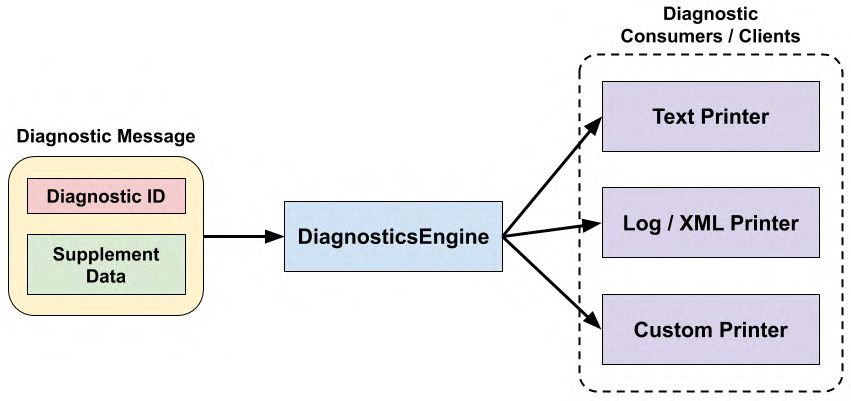
Printing diagnostic messages In Chapter 6, Extending the Preprocessor, we asked if you could improve the warning message format in the example project shown in the Developing custom preprocessor plugins and callbacks section, so that it's closer to the compiler messages you saw from Clang. One of the solutions to that question is using Clang's diagnostic framework. We are going to look at this in this section. Clang's diagnostic framework consists of three primary parts:
• Diagnostic IDs • Diagnostic engine • Diagnostic consumers (clients)
Their relationships can be seen in the following diagram:
Figure 7.5 – High-level organization of Clang's diagnostic framework
Diagnostic messages Starting from the left-hand side of the preceding diagram, most of the time, a diagnostic message – for example, use of undeclared identifier "x" – is associated with a message template that has its own diagnostic ID. Using the undeclared identifier message, for example, its message template looks like this:
"use of undeclared identifier %0"
Writing AST plugins 129
%0 is a placeholder that will be filled in by supplemental data later. In this case, it is the concrete identifier name (x, in the preceding example message). The number following % also suggests which supplemental data it will use. We will cover this format in detail shortly. Templates are registered with the diagnostic engine via TableGen syntax. For example, the message we are discussing here is put inside clang/include/clang/Basic/ DiagnosticSemaKinds.td:
def err_undeclared_var_use : Error<"use of undeclared identifier %0">;
We highlighted two parts in the preceding snippet. First, the name of this message template, err_undeclared_var_use, will be used later as the unique diagnostic ID. Second, the Error TableGen class suggested that this is an error message, or more formally speaking, its diagnostic level error. In summary, a diagnostic message consists of a unique diagnostic ID – which is associated with a message template and its diagnostic level – and the supplemental data to put in the placeholders of the template, if there are any.
Diagnostic consumers After the diagnostic message is sent to the diagnostic engine – represented by the DiagnosticsEngine class – the engine formats the messages into textual contents and send them to one of the diagnostic consumers (also called clients in the code base; we will use the term consumer in rest of this section). A diagnostic consumer – an implementation of the DiagnosticConsumer class – post-processes the textual messages sent from DiagnosticsEngine and exports them via different mediums. For example, the default TextDiagnosticPrinter prints messages to the command-line interface; LogDiagnosticPrinter, on the other hand, decorates the incoming messages with simple XML tags before printing them into log files. In theory, you can even create a custom DiagnosticConsumer that sends diagnostic messages to a remote host!
130 Handling AST
Reporting diagnostic messages Now that you have learned how Clang's diagnostic framework works, let's learn how to send (report) a diagnostic message to DiagnosticEngine:
 1. First, we need to retrieve a reference to DiagnosticEngine. The engine itself is
    sitting at the core of Clang's compilation pipeline, so you can fetch it from various
    primary components, such as ASTContext and SourceManager. The following
    is an example:
         // `Ctx` has the type of `ASTContext&`
         DiagnosticsEngine& Diag = Ctx.getDiagnostics();
 2. Next, we need to use the DiagnosticsEngine::Report function. This
    function always takes a diagnostic ID as one of its arguments. For example, to
    report err_undeclared_var_use, which we introduced earlier, use the
    following code:
         Diag.Report(diag::err_undeclared_var_use);
      However, we know that err_undeclared_var_use takes one placeholder
      argument – namely, the identifier name – which is supplied through concatenating
      the Report function call with << operators:
         Diag.Report(diag::err_undeclared_var_use) << ident_name_
         str;
 3. Recall that err_undeclared_var_use only has one placeholder, %0, so it
    picks up the first values in the following << stream. Let's say we have a diagnostic
    message, err_invalid_placement, with the following template:
         "you cannot put %1 into %0"
 4. You can report this using the following code:
         Diag.Report(diag::err_invalid_placement)
                          << "boiling oil" << "water";
 5. In addition to simple placeholders, another useful feature is the %select directive.
    For example, we have a diagnostic message, warn_exceed_limit, with a
    template like this:
         "you exceed the daily %select{wifi|cellular network}0
         limit"
Writing AST plugins 131
The %select directive consists of curly braces in which different message options are separated by |. Outside the curly braces, a number – 0, in the preceding code – indicates which supplement data is used to select the option within the braces. The following is an example of this: Diag.Report(diag::warn_exceed_limit) << 1;
The preceding snippet will output You exceed the daily cellular network limit. Let's say you use 0 as the parameter after the stream operator (<<): Diag.Report(diag::warn_exceed_limit) << 0;
   This will result in a message stating you exceed the daily wifi limit.
6. Now, let's say you use another version of the Report function, which takes an
   additional SourceLocation argument:
      // `SLoc` has the type of `SourceLocation`
      Diag.Report(SLoc, diag::err_undeclared_var_use)
                        << ident_name_str;
   The output message will contain part of the source code being pointed to by SLoc:
      test.cc:2:10: error: use of undeclared identifier 'x'
        return x + 1;
               ^
7. Last but not least, though most of the diagnostic messages are registered with DiagnosticsEngine via TableGen code put inside Clang's source tree, this doesn't mean that developers cannot create their new diagnostic messages without modifying Clang's source tree. Let's introduce DiagnosticsEngine::getCustomDiagID(…), the API that creates a new diagnostic ID from a message template and diagnostic level provided by developers: auto MyDiagID = Diag. getCustomDiagID(DiagnosticsEngine::Note, "Today's weather is %0");
The preceding snippet creates a new diagnostic ID, MyDiagID, that has a message template of Today's weather is %0 at its note diagnostic level. You can use this diagnostic ID just like any other ID: Diag.Report(MyDiagID) << "cloudy";
132 Handling AST
In this section, you learned how to leverage Clang's diagnostic framework to print out messages just like normal compiler messages. Next, we are going to combine all the skills we've learned about in this chapter to create a custom AST plugin.
Creating the AST plugin In the previous sections of this chapter, we explored Clang's AST and learned how to use it in in-memory APIs. In this section, we will learn how to write a plugin that helps you insert your custom AST processing logic into Clang's compilation pipeline in an easy way. In Chapter 5, Exploring Clang's Architecture, we learned about the advantages of using Clang (AST) plugins: they can be developed even you are using a prebuilt clang executable, they are easy to write, and they have good integration with the existing toolchain and build systems, to name a few. In Chapter 6, Extending the Preprocessor, we developed a plugin for custom pragma handling in the preprocessor. In this chapter, we will also be writing a plugin, but this one will be designed for custom AST processing. The code skeletons for these two plugins are also quite different. We introduced the sample project we will be using in this section in the Project overview section. This plugin will prompt users with warning messages if some if-else statements in the input code can be converted into ternary operators. In addition, it also shows extra hints about candidate expressions for building the ternary operator. Here are the detailed steps for building the plugin:
  1. Similar to the pragma plugin we saw in Chapter 6, Extending the Preprocessor,
     creating a plugin in Clang is basically like implementing a class. In the case of the
     AST plugin, this will be the PluginASTAction class.
      PluginASTAction is a subclass of ASTFrontendAction – a
      FrontendAction specialized for handling AST (if you're not familiar with
      FrontendAction, feel free to read Chapter 5, Exploring Clang's Architecture,
      again). Thus, we need to implement the CreateASTConsumer member function:
         struct TernaryConverterAction : public PluginASTAction {
            std::unique_ptr<ASTConsumer>
              CreateASTConsumer(CompilerInstance &CI,
                                StringRef InFile) override;
         };
We will fill in this function later.
Writing AST plugins 133
2. In addition to CreateASTConsumer, there are two other member functions
   we can override to change some of the functionalities: getActionType and
   ParseArgs. The former tells Clang how this plugin should be executed by
   returning one of the enum values shown here:
   a. Cmdline: The plugin will be executed after the main action if users provide the
      -plugin <plugin name> (frontend) command-line flag.
   b. ReplaceAction: This replaces the original action Clang was going to perform.
      For example, if Clang was supposed to compile input code into an object file
      (the -c flag), it will execute the plugin's action instead once the plugin has been
      loaded.
   c. AddBefore/AfterMainAction: The original Clang action will still be
      executed, and the plugin action will be prepended/appended to it.
   Here, we will use the Cmdline action type:
      struct TernaryConverterAction : public PluginASTAction {
         …
         ActionType getActionType() override { return Cmdline; }
      };
   The ParseArgs member function, on the other hand, handles (frontend)
   command-line options specific to this plugin. In other words, you can create custom
   command-line flags for your plugin. In our case, we are going to create two flags:
   -no-detect-return and -no-detect-assignment. This allows us to
   decide whether we wish to detect potential ternary conversions regarding return
   statements or assignment statements, respectively:
      struct TernaryConverterAction : public PluginASTAction {
        …
        bool NoAssignment = false,
             NoReturn = false;
         bool ParseArgs(const CompilerInstance &CI,
                const std::vector<std::string> &Args) override {
           for (const auto &Arg : Args) {
             if (Arg == "-no-detect-assignment") NoAssignment =
               true;
             if (Arg == "-no-detect-return") NoReturn = true;
           }
134 Handling AST
               return true;
           }
         };
      As shown in the preceding snippet, we created two boolean flags, NoReturn
      and NoAssignment, to carry our command-line options' values. An important
      thing to know is the return value for ParseArgs. Instead of returning if it parsed
      any custom flag, ParseArgs is actually returning if the plugin should continue its
      execution. Therefore, you should always return true in most cases.
 3. Now, we are going to talk about the content of CreateASTConsumer. This
    function will return an ASTConsumer object, which is the main body that we will
    put our custom logic in. Nevertheless, we are not going to directly implement an
    ASTConsumer. Instead, we are going to us the ASTConsumer object that was
    generated by ASTMatcher, which we introduced earlier in this chapter.
      Recall that two things are required to build a MatchFinder instance – the primary
      pattern matching driver in ASTMatcher (patterns written in ASTMatcher's own
      DSL) and a MatchCallback implementation. Let's separate our patterns and
      matcher callbacks into two categories: patterns for detecting potential ternary
      operator opportunities based on return statements and those for detecting
      assignment-statement-based opportunities.
      Here is the skeleton for CreateASTConsumer:
         using namespace ast_matchers;
         struct TernaryConverterAction : public PluginASTAction {
            …
         private:
            std::unique_ptr<MatchFinder> ASTFinder;
            std::unique_ptr<MatchFinder::MatchCallback>
              ReturnMatchCB, AssignMatchCB;
         };
         std::unique_ptr<ASTConsumer>
         TernaryConverterAction::CreateASTConsumer
         (CompilerInstance &CI, StringRef InFile) {
           ASTFinder = std::make_unique<MatchFinder>();
           // Return matcher
           if (!NoReturn) {
             ReturnMatchCB = /*TODO: Build MatcherCallback
Writing AST plugins 135
           instance*/
         ASTFinder->addMatcher(traverse
          (TK_IgnoreUnlessSpelledInSource,
           /*TODO: Patterns in DSL*/), ReturnMatchCB.get());
       }
       // Assignment matcher
       if (!NoAssignment) {
         AssignMatchCB = /*TODO: Build MatcherCallback
           instance*/
         ASTFinder->addMatcher(traverse
          (TK_IgnoreUnlessSpelledInSource,
            /*TODO: Patterns in DSL*/), AssignMatchCB.get());
       }
       return std::move(ASTFinder->newASTConsumer());
   }
The preceding code created three additional unique_ptr type member variables: one for holding MatchFinder and two MatchCallback ones for return-based and assignment-based patterns.
Why Use unique_ptr? The rationale behind using unique_ptr to store those three objects – or storing those objects persistently – is because the ASTConsumer instance we created at the end of CreateASTConsumer (ASTFinder- >newASTConsumer()) keeps references to those three objects. Thus, we need a way to keep them alive during the lifetime of the frontend.
In addition to that, we registered the pattern for traversal with MatchFinder by using MatchFinder::addMatcher, the traverse function, and MatchCallback instances. If you're not familiar with these APIs, feel free to check out the ASTMatcher section.
136 Handling AST
      Now, we only need to compose the matching patterns and implement some
      callbacks to print out warning messages if there is a match – as the TODO comments
      suggested in the preceding snippet.
 4. Let's deal with the patterns first. The patterns we are looking for – both return-based
    and assignment-based patterns – have if-else statements (IfStmt) enclosed by
    a function (FunctionDecl for the entire function and CompoundStmt for the
    function body) in their outermost layout. Inside both, in the true branch and false
    branch of IfStmt, only one statement can exist. This structure can be illustrated
    like so:
         FunctionDecl
           |_CompoundStmt
             |_(Other AST nodes we don't care)
             |_IfStmt
               |_(true branch: contain only one return/assign
                 statement)
               |_(false branch: contain only one return/assign
                 statement)
      To convert this concept into ASTMatcher's DSL, here is the DSL code that's shared
      between the return-based and assignment-based patterns:
         functionDecl(
            compoundStmt(hasAnySubstatement
              IfStmt(
                hasThen(/*TODO: Sub-pattern*/)
                hasElse(/*TODO: Sub-pattern*/)
              )
            )
         );
      One important thing to remember is that when you're dealing with
      CompoundStmt, you should always use quantifier directives such as
      hasAnySubstatement to match its body statements.
      We are going to use the previous TODO comments to customize for either return-
      based or assignment-based situations. Let's use subpattern variables to replace those
      TODO comments and put the preceding code into another function:
         StatementMatcher
         buildIfStmtMatcher(StatementMatcher truePattern,
Writing AST plugins 137
                            StatementMatcher falsePattern) {
           return functionDecl(
             compoundStmt(hasAnySubstatement
               IfStmt(
                 hasThen(truePattern)
                 hasElse(falsePattern))));
       }
5. For return-based patterns, the subpatterns for both the if-else branches
   mentioned in the previous step are identical and simple. We're also using a separate
   function to create this pattern:
       StatementMatcher buildReturnMatcher() {
         return compoundStmt(statementCountIs(1),
                             hasAnySubstatement(
                               returnStmt(
                                 hasReturnValue(expr()))));
       }
    As shown in the preceding snippet, we are using the statementCountIs
    directive to match the code blocks with only one statement. Also, we specified that
    we don't want an empty return via hasReturnValue(…). The argument for
    hasReturnValue is necessary since the latter takes at least one argument, but
    since we don't care what type of node it is, we are using expr() as some sort of
    wildcard pattern.
    For assignment-based patterns, things get a little bit complicated: we don't just
    want to match a single assignment statement (modeled by the BinaryOperator
    class) in both branches – the LHS of those assignments need to be DeclRefExpr
    expressions that point to the same Decl instance. Unfortunately, we are not able
    to express all these predicates using ASTMatch's DSL. What we can do, however,
    is push off some of those checks into MatchCallback later, and only use DSL
    directives to check the shape of our desired patterns:
       StatementMatcher buildAssignmentMatcher() {
         return compoundStmt(statementCountIs(1),
                             hasAnySubstatement(
                               binaryOperator(
                                 hasOperatorName("="),
                                 hasLHS(declRefExpr())
138 Handling AST
                                          )));
         }
 6. Now that we've completed the skeleton for our patterns, it's time to
    implement MatchCallback. There are two things we are going to do in
    MatchCallback::run. First, for our assignment-based pattern, we need to
    check if the LHS' DeclRefExpr of those matched assignment candidates is
    pointing to the same Decl. Second, we want to print out messages that help users
    rewrite if-else branches as ternary operators. In other words, we need location
    information from some of the matched AST nodes.
      Let's solve the first task using the AST node binding technique. The plan is to bind
      the candidate assignment's LHS DeclRefExpr nodes so that we can retrieve them
      from MatchCallback::run later and perform further checks on their Decl
      nodes. Let's change buildAssignmentMatch into this:
         StatementMatcher buildAssignmentMatcher() {
           return compoundStmt(statementCountIs(1),
                               hasAnySubstatement(
                                 binaryOperator(
                                   hasOperatorName("="),
                                   hasLHS(declRefExpr().
                                   bind("dest")))));
         }
      Though the preceding code seems straightforward, there is one problem in this
      binding scheme: in both branches, DeclRefExpr is bound to the same name,
      meaning that the AST node that occurred later will overwrite the previously bound
      node. So, eventually, we won't get DeclRefExpr nodes from both branches as we
      previously planned.
      Therefore, let's use a different tags for DeclRefExpr that match from both
      branches: dest.true for the true branch and dest.false for the false branch.
      Let's tweak the preceding code to reflect this strategy:
         StatementMatcher buildAssignmentMatcher(StringRef Suffix)
         {
           auto DestTag = ("dest" + Suffix).str();
           return compoundStmt(statementCountIs(1),
                               hasAnySubstatement(
                                 binaryOperator(
Writing AST plugins 139
                                       hasOperatorName("="),
                                       hasLHS(declRefExpr().
                                        bind(DestTag)))));
   }
Later, when we call buildAssignmentMatcher, we will pass different suffixes
for the different branches – either .true or .false.
Finally, we must retrieve the bound nodes in MatchCallback::run.
Here, we are creating different MatchCallback subclasses for return-
based and assignment-based scenarios – MatchReturnCallback and
MatchAssignmentCallback, respectively. Here is a part of the code in
MatchAssignmentCallback::run:
   void
   MatchAssignmentCallback::run(const MatchResult &Result)
   override {
     const auto& Nodes = Result.Nodes;
     // Check if destination of both assignments are the
     // same
     const auto *DestTrue =
                 Nodes.getNodeAs<DeclRefExpr>("dest.true"),
                 *DestFalse =
                 Nodes.getNodeAs<DeclRefExpr>("dest.false");
     if (DestTrue->getDecl() == DestFalse->getDecl()) {
        // Can be converted into ternary operator!
     }
   }
We are going to solve the second task – printing useful information to users – in the next step.
140 Handling AST
 7. To print useful information – including which part of the code can be converted
    into a ternary operator, and how can you build that ternary operator – we need
    to retrieve some AST nodes from the matched patterns before getting their
    source location information. For this, we will use some node binding tricks, as
    we did in the previous step. This time, we will modify all the pattern building
    functions; that is, buildIfStmtMatcher, buildReturnMatcher, and
    buildAssignmentMatcher:
         StatementMatcher
         buildIfStmtMatcher(StatementMatcher truePattern,
                            StatementMatcher falsePattern) {
           return functionDecl(
             compoundStmt(hasAnySubstatement
               IfStmt(
                 hasThen(truePattern)
                 hasElse(falsePattern)).bind("if_stmt")
             ));
         }
      Here, we bound the matched IfStmt since we want to tell our users where the
      potential places that can be converted into ternary operators are:
         StatementMatcher buildReturnMatcher(StringRef Suffix) {
           auto Tag = ("return" + Suffix).str();
           return compoundStmt(statementCountIs(1),
                               hasAnySubstatement(
                                 returnStmt(hasReturnValue(
                                   expr().bind(Tag)
                                 ))));
         }
         StatementMatcher buildAssignmentMatcher(StringRef Suffix)
         {
           auto DestTag = ("dest" + Suffix).str();
           auto ValTag = ("val" + Suffix).str();
           return compoundStmt(statementCountIs(1),
                               hasAnySubstatement(
                                 binaryOperator(
                                   hasOperatorName("="),
                                   hasLHS(declRefExpr().
Writing AST plugins 141
                                    bind(DestTag)),
                                    hasRHS(expr().bind(ValTag))
                                  )));
  }
We used the same node binding tricks here that we did in the preceding snippet. After this, we can retrieve those bound nodes from MatchCallback::run and print out the message using the SourceLocation information that's attached to those nodes. We are going to use Clang's diagnostic framework to print out those messages here (feel free to read the Printing diagnostic messages section again if you're not familiar with it). And since the prospective message formats are not existing ones in Clang's code base, we are going to create our own diagnostic ID via DiagnosticsEngine::getCustomDiagID(…). Here is what we will do in MatchAssignmentCallback::run (we will only demo MatchAssignmentCallback here since MatchReturnCallback is similar): void MatchAssignmentCallback::run(const MatchResult &Result) override { … auto& Diag = Result.Context->getDiagnostics(); auto DiagWarnMain = Diag.getCustomDiagID( DiagnosticsEngine::Warning, "this if statement can be converted to ternary operator:");
      auto DiagNoteTrueExpr = Diag.getCustomDiagID(
        DiagnosticsEngine::Note,
        "with true expression being this:");
      auto DiagNoteFalseExpr = Diag.getCustomDiagID(
        DiagnosticsEngine::Note,
        "with false expression being this:");
      …
  }
142 Handling AST
      Combining this with bound node retrievals, here is how we are going to print the
      messages:
         void
         MatchAssignmentCallback::run(const MatchResult &Result)
         override {
           …
           if (DestTrue && DestFalse) {
               if (DestTrue->getDecl() == DestFalse->getDecl()) {
                 // Can be converted to ternary!
                 const auto* If = Nodes.getNodeAs<IfStmt>
                 ("if_stmt");
                 Diag.Report(If->getBeginLoc(), DiagWarnMain);
                      const auto* TrueValExpr =
                                  Nodes.getNodeAs<Expr>("val.true");
                      const auto* FalseValExpr =
                                  Nodes.getNodeAs<Expr>("val.false");
                      Diag.Report(TrueValExpr->getBeginLoc(),
                                  DiagNoteTrueExpr);
                      Diag.Report(FalseValExpr->getBeginLoc(),
                                  DiagNoteFalseExpr);
                  }
              }
         }
 8. Finally, go back to CreateASTConsumer. Here is how everything is pieced
    together:
         std::unique_ptr<ASTConsumer>
         TernaryConverterAction::CreateASTConsumer(
         CompilerInstance &CI, StringRef InFile) {
           …
           // Return matcher
           if (!NoReturn) {
           ReturnMatchCB = std::make_unique<MatchReturnCallback>();
             ASTFinder->addMatcher(
               traverse(TK_IgnoreUnlessSpelledInSource,
                        buildIfStmtMatcher(
Writing AST plugins 143
                            buildReturnMatcher(".true"),
                            buildReturnMatcher(".false"))),
                 ReturnMatchCB.get()
               );
           }
           // Assignment matcher
           if (!NoAssignment) {
             AssignMatchCB = std::make_
              unique<MatchAssignmentCallback>();
             ASTFinder->addMatcher(
                traverse(TK_IgnoreUnlessSpelledInSource,
                         buildIfStmtMatcher(
                           buildAssignmentMatcher(".true"),
                           buildAssignmentMatcher(".false"))),
                AssignMatchCB.get()
             );
           }
           return std::move(ASTFinder->newASTConsumer());
       }
    And that wraps up all the things we need to do!
9. Last but not least, this is the command for running our plugin:
       $ clang -fsyntax-only -fplugin=/path/to/TernaryConverter.
       so -Xclang -plugin -Xclang ternary-converter \
           test.c
You will get an output similar to the one you saw in the Project overview section.
144 Handling AST
      To use plugin-specific flags, such as -no-detect-return and -no-detect-
      assignment in this project, please add the command-line options highlighted
      here:
         $ clang -fsyntax-only -fplugin=/path/to/TernaryConverter.
         so -Xclang -plugin -Xclang ternary-converter \
            -Xclang -plugin-arg-ternary-converter \
            -Xclang -no-detect-return \
             test.c
To be more specific, the first highlighted argument is in -plugin-arg-<plugin name> format. In this section, you learned how to write an AST plugin that sends messages to users whenever there is an if-else statement that can be converted into a ternary operator. You did this by leveraging all the techniques that were covered in this chapter; that is, Clang AST's in-memory representation, ASTMatcher, and the diagnostic framework, to name a few.
Summary When it comes to program analysis, AST is usually the recommended medium to use, thanks to its rich amount of semantic information and high-level structures. In this chapter, we learned about the powerful in-memory AST representation that's used in Clang, including its C++ classes and APIs. This gives you a clear picture of the source code you are analyzing. Furthermore, we learned and practiced a concise way to do pattern matching on AST – a crucial procedure for program analysis – via Clang's ASTMatcher. Familiarizing yourself with this technique can greatly improve your efficiency when it comes to filtering out interesting areas from the input source code. Last but not least, we learned how to write an AST plugin that makes it easier for you to integrate custom logic into the default Clang compilation pipeline. In the next chapter, we will look at the drivers and toolchains in Clang. We will show you how they work and how to customize them.